
Employee Experience
Office Management Hacks
Case Study

You order pizza for the team. You get five pepperoni, three cheese, and one veggie.
Then the emails start.
"Is the crust gluten-free?"
"Is the cheese rennet-free?"
"Was this cut with the same knife as the pepperoni? I eat Halal."
Suddenly, your simple "treat for the team" feels like a minefield.
If you are an Office Manager, HR professional, or Diversity Lead, you know that food is never just food. It is culture. It is healthy. It is safe. And in a modern, diverse workplace, a thoughtful office catering program is one of the most visible ways to show your employees that they belong.
But managing dietary accommodations at scale, for 50, 100, or 500 people, can feel impossible. How do you balance safety with variety? How do you ensure the vegan office lunch isn't just a sad side salad?
At Officeguru, we believe a "Good job!" starts with feeling safe and welcome. You cannot do your best work if you are worried about an allergic reaction or if you are hungry because there is nothing you can eat.
Here is your comprehensive guide to mastering the logistics of inclusive office food without losing your mind.
The first step to managing dietary needs is categorization. Not all requests are created equal, and treating them all the same is a recipe for disaster (and food waste).
You need to mentally—and logistically—separate these into three tiers.
This is the "Epipen Zone." These are life-threatening allergies or serious medical conditions.
Examples: Celiac disease (strict gluten-free), nut allergies, shellfish allergies.
The Rule: There is no margin for error. Allergen management here means strict separation. "Low gluten" is not okay for a Celiac. If you cannot guarantee safety, it is better to provide a sealed, separate meal from a specialized vendor than to risk cross-contamination at a buffet.
This is about identity and deeply held beliefs. Failing to accommodate this is an HR and culture failure.
Examples: Halal catering, Kosher, strict Veganism.
The Rule: These require trust. If you label something Halal, the meat must be certified, and it cannot have touched pork products. If you break this trust, you alienate the employee.
This is about health goals and taste.
Examples: Keto, Paleo, "trying to eat less pasta," dislike of cilantro.
The Rule: You aim to accommodate, but safety isn't the risk—satisfaction is. A Keto eater can eat an apple; they just prefer not to.
You cannot manage what you do not measure. But asking "What are your medical issues?" is a privacy violation.
You need a standardized way to collect employee dietary preferences during onboarding or through a company-wide audit.
The "Safe" Survey Framework:
Do not ask "Why?" Ask "What?" and "How strict?"
Recommended Survey Questions:
Do you have any dietary requirements? (Select all that apply: Vegan, Vegetarian, Dairy-Free, Gluten-Free, Halal, Kosher, None/Omnivore).
Is this a medical allergy, a religious requirement, or a lifestyle preference? (This helps you triage Tier 1 vs. Tier 3).
For Allergies: Is this an airborne allergy (e.g., cannot be in the same room as peanuts) or ingestion-only?
The "Sad Salad" Check: What is your favorite lunch dish? (Use this to spot trends—if 20% of your office is vegan, you need more than grilled vegetables).
Pro Tip: In the Officeguru platform, employees can manage their own dietary profiles. This removes you from the role of "keeper of the medical records" and puts the control in their hands.
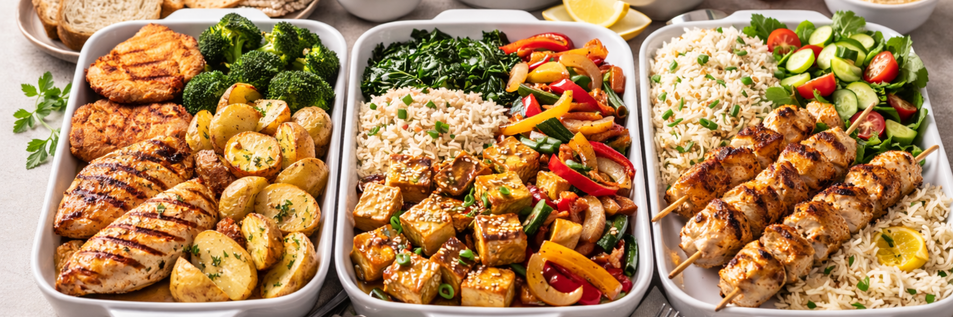 Let’s look at the three most common complex categories:
 gluten-free workplace food, vegan office lunch, and religious diets.
Gluten is tricky because it hides in soy sauce, thickeners, and dressings.
The Cross-Contamination Risk: A "gluten-free" pizza made in a standard pizza oven is often unsafe for Celiac sufferers because of flour dust in the air.
The Fix: Ask your vendor: "Do you have a dedicated prep area?" If not, order sealed, pre-packaged meals for your Tier 1 Celiac staff. For Tier 3 "avoiding bread" staff, a standard buffet catering berlin setup is fine as long as items are labeled.
The Labeling: Always label sauces. Soy sauce usually contains wheat. Tamari does not.
A vegan office lunch is often the most neglected.
The Mistake: Serving pasta with tomato sauce every day. Or removing the chicken from the Caesar salad (the dressing likely has anchovies or egg).
The Fix: Ensure the vegan option contains protein. Lentils, chickpeas, tofu, quinoa. Vegans need fuel, not just leaves.
The "Veto Vote": If you pick a steakhouse for a team lunch that has zero vegan options, the vegan employee feels excluded. Often, the whole team will switch restaurants to accommodate the one vegan. It is easier to pick an inclusive vendor from the start.
Religious dietary needs often require specific slaughter methods and strict separation from forbidden items (pork, shellfish, mixing meat and dairy).
The Mistake: Assuming "Vegetarian" is safe for everyone. It usually is, but some cheeses use animal rennet.
The Fix for Halal: Many standard suppliers use Halal chicken by default because it simplifies logistics, but you must verify. If pork is served on the same buffet, keep it on a separate table with its own serving utensils.
The Fix for Kosher: Strict Kosher rules are complex (separate kitchens). It is usually best to order specialized, sealed Kosher meals from a dedicated certified vendor rather than asking a general caterer to attempt it.
This is where most Office Managers burn out. They try to find one catering company that makes great brisket, authentic sushi, certified Halal chicken, and safe gluten-free baked goods.
That vendor does not exist.
When you force a generalist vendor to do specialized diets, quality suffers. You get dry gluten-free bread and "vegan options" that are clearly afterthoughts.
This is why a marketplace model wins for diversity. You don't need one vendor to do it all. You can mix and match.
Scenario: You have a 100-person event.
The Old Way: You order 100 sandwiches from a deli. You hope the veggie ones don't touch the ham. The gluten-free person gets a fruit cup.
The Officeguru Way: You order the main spread from a great local bistro. You add a "Pop-up" order of 15 premium vegan bowls from a top-rated plant-based specialist. You add 5 sealed Celiac-safe meals. Want to end the week with something casual? Bring in a diverse fingerfood catering berlin spread where every diet is represented in a fun, bite-sized format.
Everything arrives at the same time. One invoice. One dashboard. But everyone eats food made by an expert in that cuisine.
This is how you scale inclusive office food without sacrificing quality.
You have done the audit. You picked the vendors. The food is here.
Now comes the most critical step: The Labeling.
All your work is wasted if a staff member walks up to a tray of cookies and thinks, "I better not risk it."
Every dish on the buffet line needs a "Passport."
Name of Dish: (e.g., "Moroccan Chickpea Stew")
Dietary Badges: (V, VG, GF, DF, Halal)
The "Contains" List: (Contains: Nuts, Soy, Sesame)
The "Zone" Defense Strategy:
Arrange your buffet logically to prevent accidents.
Zone A: Vegan/Vegetarian (First in line). Why? So meat-eaters don't accidentally scoop up all the veggie options as a side dish before the vegetarians get there. Also, it prevents meat spoons from dripping into veggie trays.
Zone B: General Proteins/Sides.
Zone C: The "Danger Zone" (Items with nuts or pork). Keep these slightly separated or clearly marked in red.
Even with the best system, a vendor might send a salad with cheese when you asked for vegan.
1. The Immediate Fix:
Do you have a backup? Keep a stash of frozen, high-quality, diverse meals (like premium frozen vegan/GF bowls) in the office freezer. It is not perfect, but it is better than hunger.
2. The Communication:
Own it. "Team, the vendor sent the wrong salad. It contains dairy. We have labeled it clearly. I am sorting a refund and a replacement for those affected."
3. The Feedback Loop:
Use the Officeguru platform to flag this instantly. If a vendor repeatedly fails on allergen management or dietary requests, our system flags them. We take this seriously so you don't have to fight the battle alone.
It is easy to look at a list of dietary requirements and see it as a hassle. "Why can't everyone just eat sandwiches?"
But flip the perspective.
When a Muslim employee sees a clearly labeled Halal option, they feel seen.
When a Celiac employee sees a sealed, safe meal from a reputable GF bakery, they feel safe.
When a Vegan employee sees a meal that looks delicious—not just a pile of lettuce—they feel valued.
Stop juggling five different PDF menus and spreadsheets. Use Officeguru to build a flexible, inclusive food program that caters to every diet without the headache. Ready to simplify your lunch logistics? Go ahead and sign-up today to start building your customized, inclusive lunch profile!