

Office Management Hacks
Workplace Experience
Office Cleaning


As an Agile Startup Manager, flexibility is your greatest asset. You pivot your product roadmap, you scale your team based on quarterly funding, and you constantly re-evaluate your software subscriptions. Yet, when it comes to facility management, traditional vendors expect you to operate like a legacy corporation. They hand you a rigid, 24-month contract for daily maintenance, assuming your office headcount and usage will remain identical for the next two years.
But admin of cleaning is the only thing more boring than manager 1:1's. Luckily, you can leave it to us. You need to know your options before signing away your operational budget. Understanding the strategic differences between long-term agreements and time-limited cleaning services is critical for a growing company. Whether you need a daily reset or just a massive spring office cleaning to prep for a new board meeting, your cleaning schedule should adapt to your business—not the other way around.
A "Good job!" is mutual. It requires effort from your team, but it also requires the right conditions provided by the company. At Officeguru, we believe those conditions should be easy to manage and completely adaptable to your growth stage.
This guide breaks down the pros and cons of ongoing contracts versus one-off or seasonal cleaning. We will help you evaluate if you actually need a 12-month lock-in, and show you how to maintain a pristine workspace while keeping your operations lean and agile.
Why do traditional cleaning companies push so hard for 12-to-24-month contracts? The answer is simple: guaranteed revenue.
For legacy cleaning agencies, locking a client into a multi-year agreement reduces their administrative overhead and guarantees their cash flow. But for an agile startup, a long-term contract is often a trap.
Consider the reality of a scaling company:
If you are locked into a rigid contract, adapting to these changes is a nightmare. Upgrading your service level often triggers a total contract renegotiation at unfavorable rates. Worse, if you move offices or decide to implement a fully remote month in August, you are still legally obligated to pay for a daily cleaning crew to wipe down 35 empty desks.
To make the right decision, you need to clearly define the two main approaches to facility maintenance.
This is the industry standard. It involves hiring a vendor to perform continuous, scheduled maintenance (daily, tri-weekly, or weekly) for an indefinite or long-term contracted period.
What it includes: These are your standard general office cleaning services. The crew empties the bins, wipes the kitchen counters, restocks the toilet paper, and vacuums the main walkways.
The Pros:
The Cons:
Time-limited (or befristete) cleaning means engaging a vendor for a strictly defined timeframe or for a single, specific project. There is no auto-renewal and no long-term lock-in.
What it includes: This model is used for intensive resets, post-event cleanups, move-in/move-out services, or short-term coverage (e.g., hiring a premium crew for exactly three months while your company transitions between headquarters).
The Pros:
The Cons:
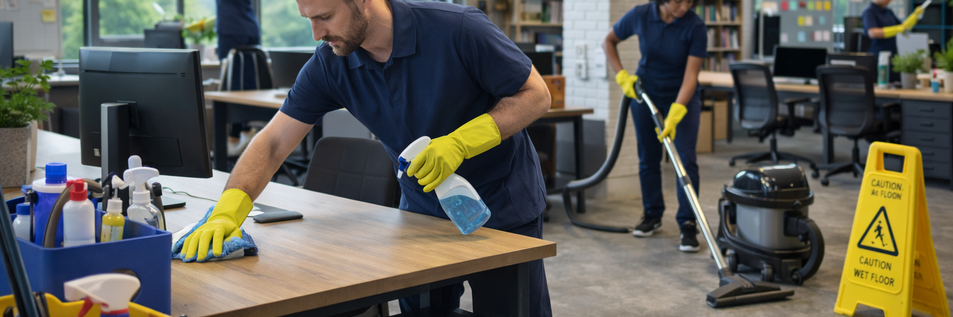
For many agile startups with hybrid work models, a massive daily cleaning contract is overkill. If your team is only in the office Tuesday through Thursday, and they are generally respectful of the space, you might only need a light weekly wipe-down.
However, a light weekly wipe-down does not address the slow accumulation of deep grime. This is where the strategic use of seasonal, time-limited projects—like a massive spring office cleaning—becomes a game-changer.
When dust bunnies throw a party, you shut it down. A professional spring clean is the ultimate reset button. It targets everything a regular daily cleaner ignores:
By pairing a very lean, basic weekly cleaning schedule with two massive, time-limited deep cleans per year (one in spring, one in late autumn), startups can save thousands of euros annually while actually maintaining a higher standard of environmental health.
The size of your physical space heavily dictates your contract needs. When you are managing a boutique agency or an early-stage startup, your requirements for small office cleaning services are fundamentally different from an enterprise headquarters.
A small office (under 300 square meters) usually has a single communal kitchen, one or two bathrooms, and a single open-plan bullpen. Because the footprint is small, dirt accumulates faster, but it is also much faster to clean.
If you manage a small space, you are in the perfect position to leverage flexible contracts. You do not need a vendor to commit a dedicated, full-time porter to your building. You simply need a reliable, vetted crew to come in for two hours, twice a week, on a rolling monthly basis.
Do not let an agency convince you that your small office requires a 12-month, multi-thousand-euro commitment. Demand a flexible, time-limited trial period first.
When startup managers realize their office is a mess, their first instinct is to type office cleaning near me into a search engine. They click the first local agency that pops up, sign the standard template contract presented to them, and move on to their next task.
This reactive approach is how agile companies get stuck with bad vendors.
When you search locally without a vetting mechanism, you expose yourself to:
Instead of rolling the dice on a local search query, modern managers use curated marketplaces. You need a platform where you can compare vetted providers, view their labor compliance, and—most importantly—select vendors who willingly offer flexible, time-limited terms.
.png?width=953&height=317&name=Design%20uden%20navn%20(5).png)
Before you sign your next facility management agreement, run your startup through this quick evaluation framework to determine your actual needs:
Look at your badge-swipe data or Wi-Fi logs. Does your office occupancy fluctuate by more than 30% from week to week? Are you planning a "work from anywhere" month this summer?
Are you planning a Series A or B funding round in the next 8 months? Will that funding trigger an immediate hiring surge or an office relocation?
Is the office generally tidy, but the carpets look gray and the windows are filthy?
If a dry biscuit is the answer, you're asking the wrong question. The same goes for facility management. Are you spending three hours a week arguing with your current cleaners about missed trash cans?
Your startup's operational agility should extend to every corner of your business, including the physical workspace. You do not have to accept the rigid, long-term contracts dictated by legacy cleaning companies.
By understanding the difference between regular ongoing maintenance and strategic, time-limited deep cleans, you can build a facility strategy that perfectly matches your company's growth stage, occupancy rates, and budget.
Ready to escape the trap of the 24-month lock-in and find a truly flexible partner? Sign up here to explore the Officeguru platform. Compare vetted, modern service providers, book a massive seasonal reset, and manage your flexible contracts all in one place with the best service companies in Berlin. Keep your office pristine, and keep your startup agile.
%20(98)-1.png?width=940&height=788&name=Unavngivet%20(Facebook-opslag)%20(98)-1.png)