
Employee Experience
Office Management Hacks
Case Study
%20-%202026-03-16T150004.076-1.png?width=940&height=788&name=Unavngivet%20(Facebook-opslag)%20-%202026-03-16T150004.076-1.png)

In recent years, the options for working from home have become more flexible and after the coronavirus pandemic, when everyone suddenly had to work from home, more people - employees, bosses and managers alike - have become aware of many of the positive opportunities and benefits that working from home offers. But how do you set up the optimal home office? What are the rules and requirements for a home office? And what about equipment, work environment and other advantages or disadvantages? Read on as Officeguru dives into the home office.
Because it has to make sense both for the company and - to a large extent - for the employees, there are a number of requirements for the home office. It's important that employees have optimal working conditions and that there is a proper working environment at the home workplace. However, the employer must ensure, and the employee must contribute to, that the conditions at the home workplace are fully safe in terms of both health and safety.
It is important to note that according to the Working Environment Act, there is a difference between working from home and having a home workplace.
Working from home: When you work from home less than one day a week on average. In this case, the Working Environment Act does not apply, and as an employer you are therefore not obliged to provide the employee with home workplace equipment.
Home workplace: If you work from home more than one day a week on average, there are a number of requirements for the layout of the home workplace and home workplace equipment that the employer must comply with. However, new home workplace rules are expected to come into force from April 2022. Instead, it is more than two days a week, averaged over approximately one month.
Source: IDA
It's important that your employees who work from home have proper conditions. This is important both for the well-being, health and health of your employees, but also for the employer, as there are a number of requirements for home workplace design and the working environment that must be complied with, and as it provides job satisfaction and increased efficiency when you take care of your employees.
In general, the Working Environment Act stipulates the following requirements for home workplaces and home workplace equipment:
The employee's desk and chair must fit both in sitting height and working height.
There is no requirement for a height-adjustable desk.
When using a monitor, the home workstation must have a separate monitor and keyboard so that the employee can work properly and in appropriate working positions
Source: Danish Ministry of Employment
The new rules for working from home
Due to the high demand for working from home after the corona pandemic, in February 2022, the Danish Parliament adopted a number of new rules for working from home, which are expected to come into force during April 2022. Among other things, some special screen rules were adopted:
Employees are allowed to use their own private desk, chair and computer, as long as the equipment complies with requirements such as a separate screen and keyboard and an adjustable chair.
If the employee's own home workplace equipment does not meet the requirements, it is the employer's responsibility to ensure that the employee has both equipment and furniture available, such as computer, keyboard, monitor, mouse, lamp, chair, etc.
In addition, the threshold defining a home workspace was changed from “more than one day per week” to “more than two days per week”, calculated as an average over approximately one month. This rule applies to screen work at fixed workplaces, at home, and at varying workplaces.
Source: Danish Ministry of Employment
Beyond legal requirements, there are several factors managers should consider to create optimal conditions for employees working from home—and for the company as a whole.
As a manager, it’s beneficial to structure and plan remote workdays clearly, giving employees defined frameworks for working from home. Rather than arbitrarily assigning one or two remote days per week, start with the tasks that need to be completed.
Are there certain days when it makes sense for employees to work from home? And others where physical presence is important? Decide which tasks are best handled at the office and which can be done remotely, and involve employees in the discussion before coordinating accordingly.
The following sections on advantages and disadvantages can also serve as a basis for developing a remote work policy.
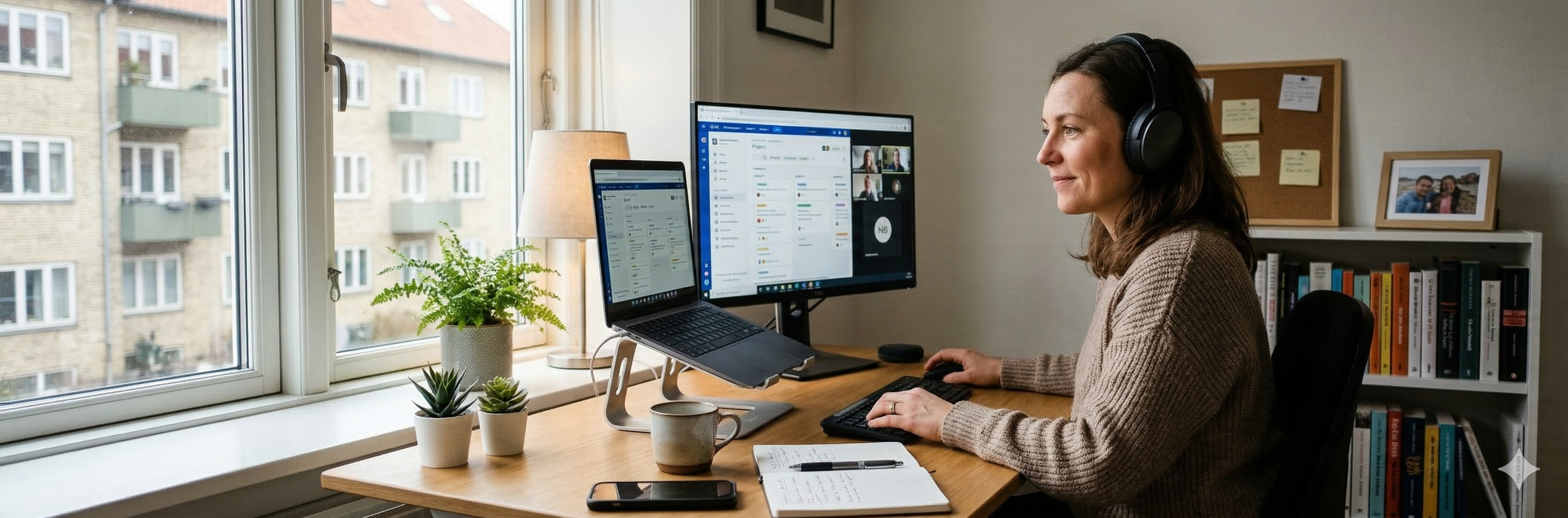
Just as there are pros and cons for your employees to work from home, there will also be pros and cons for you as a manager to let your employees use a remote workspace. In addition, it requires you as a manager to manage remotely and set the optimal framework and expectations for working from home. It also requires that a number of guidelines are drawn up regarding the need for presence in connection with meetings, courses, project work, customer service, etc. for example, telephone service, work organization, meetings, information, etc.
Potential benefits of letting your employees work from home:
Your employees will be more satisfied and thus have higher job satisfaction, more motivation and be more efficient because you give them flexibility.
Productivity increases because employees can often work undisturbed when working from home.
When you give employees the option to work from home, it helps retain current employees and recruit new, talented employees because it's beneficial for employees to have the option to work from home.
It will be easier to put together cross-organizational/cross-disciplinary teams when it happens virtually, rather than physically moving them.
You provide better opportunities for your employees who work well on their own and don't have to expend energy being in a physical environment.
Potential downsides of letting your employees work from home:
If your employees work from home a lot, it can weaken your daily contact with employees. Values-based management requires eye contact, presence, etc. and is therefore more difficult to practice when you only have virtual contact with employees.
If you don't have a structure in place for working from home, it can lead to doubt and uncertainty around work tasks.
You may need to invest in office furniture and other work from home equipment if your employees have to work from home more than two days a week.
There is greater vulnerability to IT issues, such as technical problems or security challenges (e.g. in the form of hacking).
There will be breaches of trust, because yes, there will be cases where people abuse trust and take a break instead of working efficiently.
Source: arbejdsmiljøweb.dk. and article from Officeguru: "The recipe for the hybrid workplace". NB: This is not an exhaustive list
As with so many things, there are both pros and cons to working from home, as sitting at home and being able to immerse yourself can provide peace of mind, but can also make it difficult to separate work from home. In addition, working from home requires a work environment that is just as good as the office workplace.
Potential benefits of working from home:
The workday can be planned more flexibly, making it easier for you to balance work, family life and leisure time.
You'll potentially get more peace and quiet and avoid interruptions from colleagues popping in to ask questions every now and then - many experience greater efficiency when working from home.
You save time and money on transportation.
It gives you a good feeling that your boss/supervisor trusts you when you are allowed to work from home.
You are in charge of planning your day and therefore have more influence and ownership of your work situation.
Potential disadvantages of working from home:
It requires a lot of self-discipline and planning so that you neither work too much nor too little.
If your family is at home, it can be difficult to find peace and you may experience distractions, temptations and procrastination if you work at home (e.g. vacuuming, mowing the lawn, drinking coffee with your partner or a neighbor).
You risk missing out on knowledge sharing and sparring with colleagues (although knowledge sharing can also be facilitated by going virtual).
You risk weakening your social and professional ties with colleagues and bosses, potentially leading to feelings of isolation, loneliness and lack of feedback.
An optimal home workspace requires plenty of space, and there are high standards for the work environment at your home office - it should be as ergonomically sound as in the office.
When you're working from home, a lot of communication will take place via email. Emails offer great opportunities for misunderstandings, misinterpretations and grudges (because they can't be retracted, they stick around).
Source: arbejdsmiljøweb.dk. and article from Officeguru: "The recipe for the hybrid workplace". NB: This is not an exhaustive list
In addition to organizing your home office equipment, such as computer, monitor, keyboard and office furniture, there are also other things you can make sure to consider when setting up your home office.
Find a separate room
If you have the space and ability to find a separate room for your home office, this is a great way to separate your work from the rest of your home. If you live in a small space, this can be a challenge. Instead, think about solutions such as not sitting in your bedroom or too close to your bed to avoid feeling like you're working where you sleep.
Create a space with personality
To make your home office comfortable to spend time in, try to add a little personality to the space and make it a nice place to be. You can decorate it in some happy colors, maybe hang a nice picture, or decorate with things that motivate you and make you happy to look at.
Ensure good lighting
It's crucial that you have good light to work in. It's important that you have both natural and comfortable daylight coming in, but also that you have proper lighting available in the form of lamps. If possible, it's a good idea to arrange it so that you can also cover the light from the outside with a curtain if the sun's rays hit right where you're sitting during the day.
Keep good order
When you need to concentrate, it can be difficult if there is too much clutter around you in the form of paper, envelopes, wires, etc. It's a good idea to come up with good storage solutions, such as neat boxes or drawers where you can store things out of the way.