
Employee Experience
Office Management Hacks
Case Study
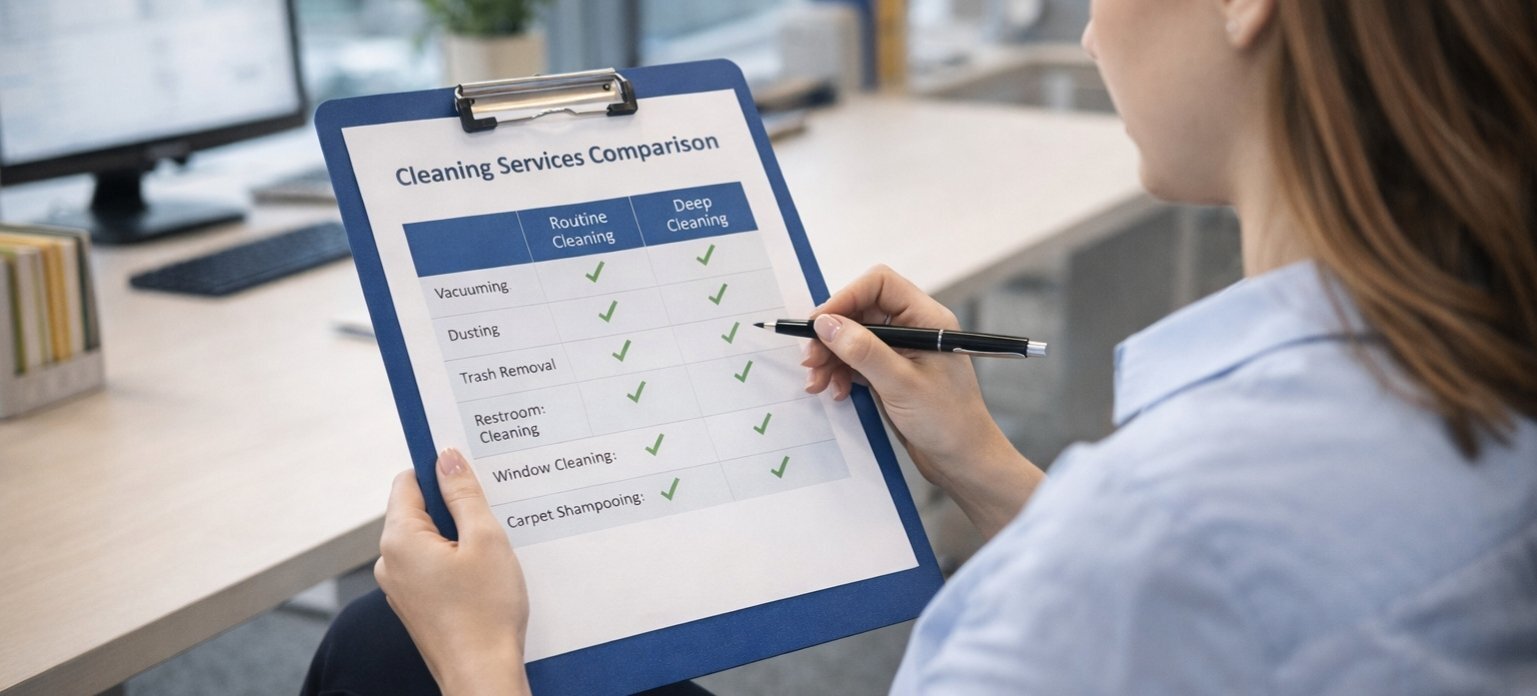

Stepping into a new role as an Office Manager means inheriting a lot of moving parts. Suddenly, you are responsible for the coffee machine, the snack budget, and ensuring the workspace actually looks like a place where people want to work. When it comes to facility management, the most confusing part is usually the cleaning contract. You look at the vendor agreement and wonder what you are actually paying for. If you don't know the exact definition of routine cleaning, you might assume every coffee spill and dusty baseboard is covered by your monthly fee. But when you ask for a carpet shampoo and get hit with unexpected deep cleaning prices, your operational budget takes a hit.
A "Good job!" is mutual. It requires effort from your team, but it also requires the right conditions from the company. You cannot expect high performance in a messy, unhygienic workspace. To build a solid foundation for your office, you need to define clear scopes of work.
This guide breaks down exactly what is included in standard maintenance versus intensive resets. We will explore the price differences per square meter, outline how often you need each service, and map out the hidden "extras" so you never face a surprise invoice again.
When managers ask, what is routine cleaning, the simplest answer is: it is the baseline. It is the regular, ongoing maintenance designed to keep your office looking presentable, smelling fresh, and functioning safely on a day-to-day basis.
Routine cleaning does not fix long-term wear and tear. It manages the immediate byproduct of humans working, eating, and moving in a shared space. Think of it as the daily reset button. It ensures that when your team walks in at 8:00 AM, the bins are empty, the toilets are stocked, and the kitchen is ready for the morning coffee rush.
A standard professional cleaning contract for routine maintenance usually includes the following tasks, performed daily or several times a week:
What this means for your workday: Routine cleaning removes micro-frustrations. It ensures your colleagues don't have to spend the first ten minutes of their morning wiping away yesterday’s lunch crumbs before they can open their laptops.
.png?width=953&height=317&name=Design%20uden%20navn%20(9).png)
If routine cleaning is the daily reset, what is deep cleaning? Deep cleaning is the intensive, top-to-bottom restoration of your office space. It targets the dirt, grime, and bacteria that accumulate slowly over time in hard-to-reach places.
While routine cleaners wipe around the microwave, deep cleaners scrub the burnt soup off the inside ceiling of it. While routine cleaners vacuum the main walkways, deep cleaners move the desks to extract the dust bunnies hiding near the power outlets. This is often referred to as a spring office cleaning, though it should happen more than just once a year.
Deep cleaning requires specialized chemicals, heavy-duty equipment, and significantly more labor hours. The scope typically includes:
What this means for your workday: Deep cleaning protects your company’s physical assets. It extends the life of your expensive office chairs and carpets, prevents foul odors from settling permanently into the kitchen, and significantly improves the overall indoor air quality.
Price is where the confusion peaks. Because these two services require vastly different levels of effort, the pricing models reflect that.
Routine cleaning prices are generally calculated as a flat monthly fee, based on an estimated hourly rate or a low cost per square meter. Because the tasks are predictable and repetitive, cleaning companies can easily forecast the labor required.
Deep cleaning is almost always quoted as a separate, one-off project. Because it requires heavy machinery (like carpet extractors) and specialized labor, the deep cleaning prices per sqm are significantly higher than routine rates.
This is the most critical section for a new Office Manager. The number one reason facility budgets get blown out of the water is a misunderstanding of what is "routine" and what is an "extra."
Vendors keep their routine quotes competitive by keeping the daily scope tight. If it is not explicitly written in the routine contract, it will cost you extra. To avoid surprise invoices, you must map out these boundaries before you sign an agreement.
Here are the most common "extras" that catch new managers off guard:
The Assumption: The cleaners will throw away old food and wipe down the fridge. The Reality: Routine cleaners will usually wipe the outside handle. Opening the fridge, throwing away Dave's three-week-old pasta, taking out the shelves, and scrubbing spills is a deep cleaning task. How to handle it: Specify a "Fridge Clean-Out" as an extra line item once a month, or implement a strict internal policy where employees must empty the fridge every Friday afternoon.
The Assumption: The cleaners will wash the glass meeting room walls. The Reality: Routine cleaners will usually spot-clean smudges and fingerprints around the door handles. Full top-to-bottom glass washing, especially anything requiring a step ladder, is considered an extra service. How to handle it: Request a separate quote for interior glass washing to be done quarterly.
The Assumption: The carpet will always look clean because they vacuum daily. The Reality: Vacuuming removes loose, surface-level dirt. It does not remove spilled coffee, tracked-in winter mud, or deep-seated allergens. Over time, the carpet will look dull. How to handle it: Budget for professional carpet extraction (shampooing) twice a year. This is a classic extra cost that you must plan for.
The Assumption: The cleaners will run the dishwasher at night and empty it in the morning. The Reality: If your office has a high volume of dishes, this can consume a massive amount of the cleaner's time. Some vendors include one load per night. If you have three dishwashers running constantly, vendors will charge extra for the labor time. How to handle it: Clarify exactly how many dishwasher cycles are included in the daily scope.
The Assumption: The cleaners wipe down our desks, so they wipe the chairs too. The Reality: Cleaners wipe hard surfaces. Fabric office chairs absorb sweat, dust, and food crumbs. Cleaning them requires specialized upholstery machines. How to handle it: Add chair deep-cleaning to your annual maintenance budget.
By mapping these out, you move from reactive spending to proactive budgeting. You can look at a vendor's proposal and confidently ask, "I see vacuuming is included, but what is the rate for bi-annual carpet extraction?"
.png?width=953&height=317&name=Design%20uden%20navn%20(10).png)
If routine cleaning happens daily or weekly, how often do you need to push the deep cleaning reset button? The answer depends on three main variables: foot traffic, office layout, and the season.
For a standard corporate office with typical desk work and a moderate number of employees, the recommended frequency is:
If your office hosts frequent events, has clients walking in and out daily, or operates in a hybrid model where desks are shared (hot-desking), your frequency needs to increase. Hot-desking, in particular, spreads germs much faster across different workstations.
Winter brings salt, snow, and mud into your reception area, tearing up carpets and dulling hard floors. Flu season brings an increased need for deep sanitation. We highly recommend scheduling one of your deep cleans at the end of winter (the classic spring office cleaning) to extract salt and mud, and another right before cold and flu season peaks in the late autumn.
Do not let vendors hand you a generic contract. As the Office Manager, you should dictate the terms. Before you request quotes, build a clear Scope of Work (SOW) using this checklist:
When you define the scope clearly, vendors cannot hide behind vague language. You compare apples to apples, and you protect your budget.
Managing an office is about removing friction, so your team can focus on their actual work. Dust bunnies and overflowing bins are distractions. A clean office is the silent baseline of a productive workday.
By understanding the distinct differences between routine maintenance and deep cleaning, you can build a facility strategy that makes sense. You will know exactly what your monthly retainer covers, you will budget accurately for seasonal deep cleans, and you will never be caught off guard by an extra invoice for carpet shampooing again. You are now equipped to negotiate like a seasoned pro.
Ready to take the hassle out of finding reliable service providers in Berlin for your space? Sign up here to explore the Officeguru platform. You can easily compare vetted cleaning vendors, define your scopes with total transparency, and get back to focusing on the bigger picture of office management.