
Employee Experience
Office Management Hacks
Case Study
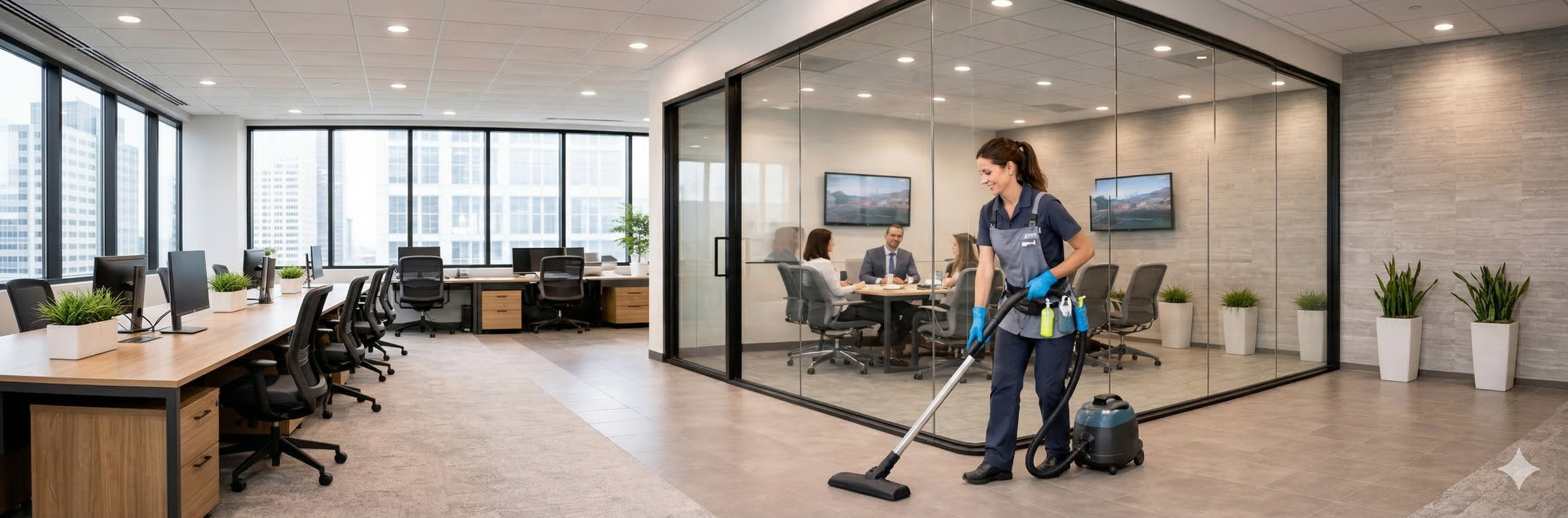

Managing an enterprise-level facility is not just about keeping the lights on and the floors swept. It is an exercise in complex risk management. When you are overseeing tens of thousands of square meters across multiple building blocks, procurement cannot be based on a handshake or a quick Google search. Securing reliable commercial office cleaning contracts requires a structured, formal approach that protects your company from legal liability, operational failures, and budget overruns.
At Officeguru, we believe a "Good job!" is mutual. It requires effort from your team, but it also requires the right conditions provided by the company. A hygienic, well-maintained building is the foundation of those conditions. To achieve this at scale, you need to partner with the right office building cleaning services through a bulletproof tender process.
This guide is designed for Enterprise Facility Managers and Procurement Officers. We will break down exactly which platforms provide the most reliable tenders, what you must consider when evaluating bids, and provide a strict playbook for avoiding the hidden compliance traps that plague commercial cleaning contracts.
Procuring services for a massive corporate campus is fundamentally different from hiring small office cleaning services for a boutique agency. At the enterprise level, the financial stakes are higher, the operational requirements are vastly more complex, and the legal exposure is significant.
When you award a multi-year contract for office building cleaning, you are inviting dozens of external workers into your facility daily. They will have access to sensitive areas, expensive equipment, and your employees' workspaces. If the vendor you choose cuts corners on background checks, underpays their staff, or lacks proper insurance, the liability often travels right back up the chain to you—the client.
Your goal during the tender process is not simply to find the cheapest hourly rate. Your goal is to find a financially stable, compliant, and operationally capable partner who can deliver consistent results without introducing risk into your organization.
When it is time to issue a Request for Proposal (RFP) or a formal tender, you need to ensure your documentation reaches qualified, vetted suppliers. The days of simply posting a PDF on your company website and hoping for the best are over.
So, which platforms provide the most reliable tenders and contracts for building cleaning? It depends on your sector, but the primary avenues include:
If you are operating within the public sector, or if your enterprise is mandated to follow public procurement rules, you must use official government or regional tender portals (such as TED - Tenders Electronic Daily in the EU). These platforms ensure legal compliance with public spending laws and enforce strict transparency. However, they are often administratively heavy and attract a high volume of unqualified bids that you must manually filter.
Large corporations often use established e-procurement software like SAP Ariba, Coupa, or Jaggaer. These platforms allow you to invite your existing network of suppliers or open the bid to pre-registered vendors on their network. While these tools are excellent for managing the flow of documentation and standardizing contracts, they do not inherently vet the quality of the business and office cleaning services bidding on your project. You still have to do the heavy lifting of due diligence.
For private enterprises looking for speed without sacrificing security, vetted marketplaces like Officeguru provide a highly reliable alternative to open tenders. Instead of broadcasting your RFP to the wild west of the internet, you access a closed network of pre-vetted suppliers. Every office cleaning agency on the platform has already passed initial compliance, insurance, and quality checks. This drastically reduces the time you spend on pre-qualification and ensures you are only comparing high-quality, capable vendors.
The commercial cleaning industry is highly competitive, which sometimes leads to aggressive pricing strategies. As a procurement officer, you must be hyper-vigilant. Accepting a bid that seems "too good to be true" often means walking straight into a legal trap.
Here is your playbook for identifying and avoiding the most common compliance pitfalls when awarding a contract to a commercial office cleaning business.
This is the single biggest risk in facility procurement. You award the contract to a reputable, well-presented agency. However, to keep their margins high, they secretly subcontract the work to a smaller company, who then subcontracts it to independent, unregistered workers.
Cleaning is a labor-intensive industry. The only way a vendor can drastically undercut the market price is by underpaying their staff or violating collective labor agreements.
Accidents happen. A cleaner might accidentally unplug a critical server, use the wrong chemical on an expensive hardwood floor, or leave a tap running, flooding a newly renovated floor.
Once you have filtered out the non-compliant bids, you need an objective framework to award the contract. The most successful enterprise facility managers evaluate bids using a weighted scoring matrix.
When reviewing proposals, consider the following four pillars:
You need a partner who will be around for the duration of the three-to-five-year contract. Request audited financial statements or a credit report. A financially unstable vendor will eventually cut corners on supplies, delay paying their staff (leading to high turnover and poor service), or go bankrupt mid-contract, leaving your building unserviced.
Who is actually managing the cleaners? A common mistake is buying a great pitch from a sales director, only to find out the on-site cleaners have no supervision.
For modern enterprises, ESG (Environmental, Social, and Governance) reporting is mandatory. Your cleaning vendor plays a major role in your Scope 3 emissions and environmental footprint. Evaluate their use of eco-friendly, highly concentrated chemicals, their waste reduction protocols, and whether they hold recognized environmental certifications (like the EU Ecolabel or ISO 14001).
Never sign a contract based on a vague promise to "keep the building clean." You must establish a strict Service Level Agreement (SLA). The SLA should define exact Key Performance Indicators (KPIs), such as response times to ad-hoc requests, monthly audit scores, and consumable restocking metrics.
More importantly, the contract must define the consequences of failing to meet these KPIs. Include a malus/bonus system: if the vendor consistently fails their quality audits, financial penalties should automatically apply to their monthly invoice.
The foundation of a secure contract is a flawless Scope of Work (SOW). If a task is not explicitly written in the SOW, you cannot legally hold the vendor accountable for it.
For large-scale facilities, divide your SOW into three distinct categories:
What this means for your workday: A highly detailed SOW eliminates arguments. When a manager complains that the boardroom windows look dusty, you don't have to argue with the vendor. You simply check the SOW, confirm that interior glass is a weekly deliverable, and hold the vendor to the contract. It transforms facility management from emotional firefighting into objective contract administration.
Awarding the contract is only the first step; the transition is where most failures occur. Moving from one enterprise vendor to another is a massive logistical operation.
Ensure your new contract includes a mandatory 30-to-60-day mobilization phase. During this time, the new vendor must audit the site, procure necessary equipment, order uniforms, and finalize the hiring and background checks of their staff. Require the vendor to submit a detailed transition plan as part of their tender response. A vendor who cannot map out exactly how they will take over your building on day one is not ready for an enterprise contract.
Awarding a commercial cleaning contract for a massive facility is a heavy responsibility. The risks of non-compliance, legal liability, and operational disruption are real. However, by treating the procurement process as an exercise in risk management rather than just a price comparison, you protect your company and your colleagues.
By utilizing vetted platforms, demanding transparency in labor practices, enforcing strict SLAs, and writing an uncompromising Scope of Work, you take total control of your facility's baseline. You ensure that when your team walks into the building every morning, the environment is safe, hygienic, and perfectly primed for them to do a good job.
Ready to streamline your enterprise procurement without the compliance headaches? Sign up here to explore the Officeguru platform. Connect with pre-vetted, highly reliable service providers in Berlin, manage your contracts securely in one place, and elevate your workplace experience with total peace of mind.